Projects · ORCNEIT
ORCNEIT Contributors: language starts with people
The same phrase can express gratitude, support or frustration. We built a place where you can help explain not just the words, but the meaning behind them.
Published:
Screenshots show the actual interface with fictional examples in an isolated demonstration. No user data is used.
“Thanks a lot.” What did you mean?
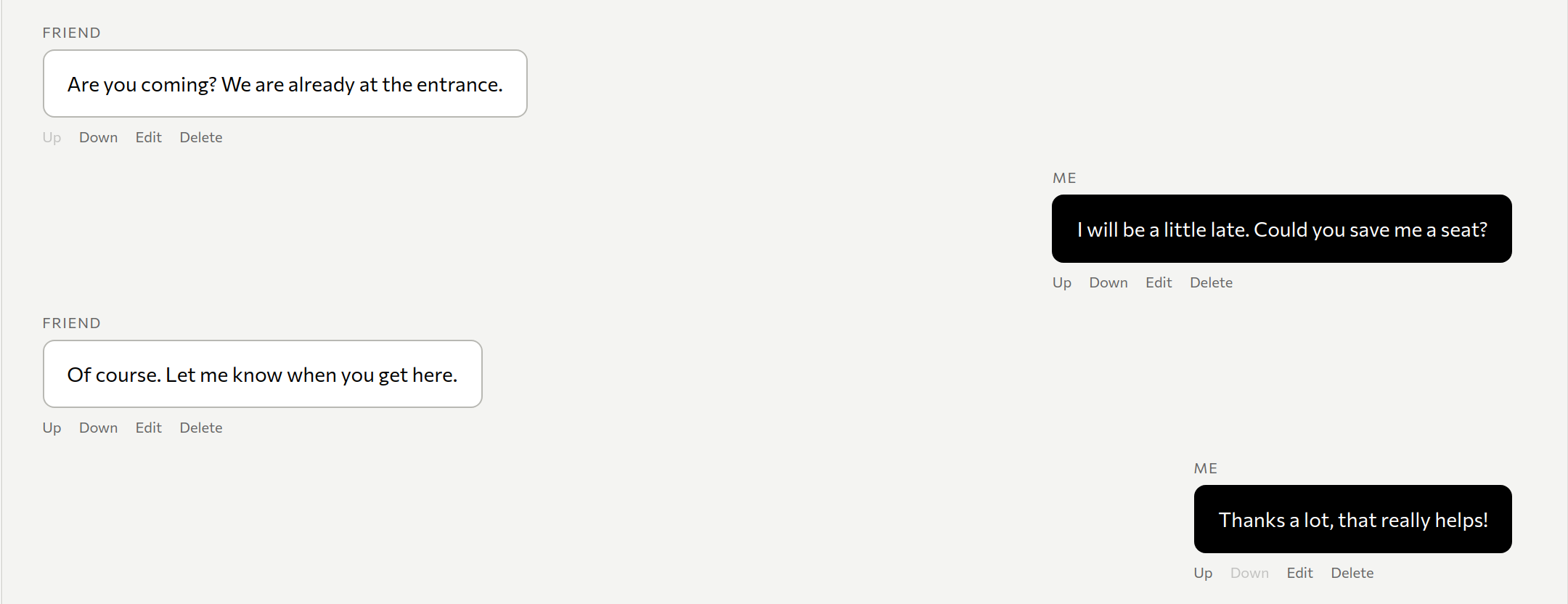
A friend saved you a seat while you were stuck in traffic. “Thanks a lot, that really helps!” The meaning is clear: you are grateful. Now imagine someone closes your work without saving it. “Thanks a lot.” The words are the same, but the meaning is not.
People often recognise the difference immediately. We hear the tone, remember what happened and understand the relationship. Written text leaves much of that out. A dictionary definition is not enough: the situation matters.
That question is a good place to begin with ORCNEIT Contributors. How do we capture not just a phrase, but what a person actually meant?
Why we came to Contributors
While working on its language model, ORCNEIT faced a practical challenge: the Russian-language texts available to us did not offer enough examples of how people communicate today. Books, including older literature, preserve a rich part of the language. But literary writing cannot replace a conversation with a friend, a joke in a game chat or a short message whose meaning depends on the previous reply.
We needed more than texts alone. We needed human explanations: why something sounds natural here, what an abbreviation means, and when a joke stops being a joke. No single person knows the language of every community equally well.
That led to the idea of a place where people could create their own examples and explain expressions they know. Contributors invites the people who use language every day to take part. You do not need to be a researcher or a linguist.
Start with a conversation you could actually hear
In Materials, you can write free text, create a dialogue or prepare text with explanations. Choose a format, give your material a title and start writing. This is not a chat with artificial intelligence: the author writes both sides of the dialogue.
Imagine one person explaining a game to another. Or friends arranging a meeting with very different ideas of what “soon” means. Set up two roles and add messages for each participant. What matters is a clear situation, connected ideas and natural language, not an artificially formal tone.
If you prefer a story, description or opinion, choose free text. It does not need to read like a textbook. Write it yourself; do not copy someone else's private conversation or present another person's work as your own.
Familiar words do not always mean the same thing
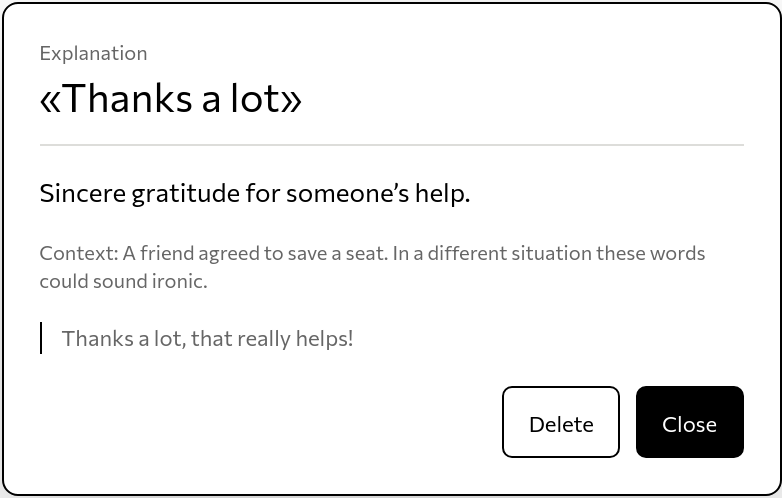
You can explain an individual word or expression within a material. Describe what it means here, when it is used and add an example of your own. This brings something into view that otherwise has to be guessed: the author's intention and the context.
The editor can also suggest an expression that may need an explanation. A suggestion does not mean the word is wrong or prohibited. It is an invitation to explain it. Once you add an explanation, a marker remains so it can be read.
“Thanks a lot” shows why this matters. “Gratitude” does not fit every conversation. Sometimes the more accurate explanation is: “The speaker is frustrated and being ironic.” The value lies not in repeating a word, but in the distinctions you help reveal.
No topic in mind? Try a task
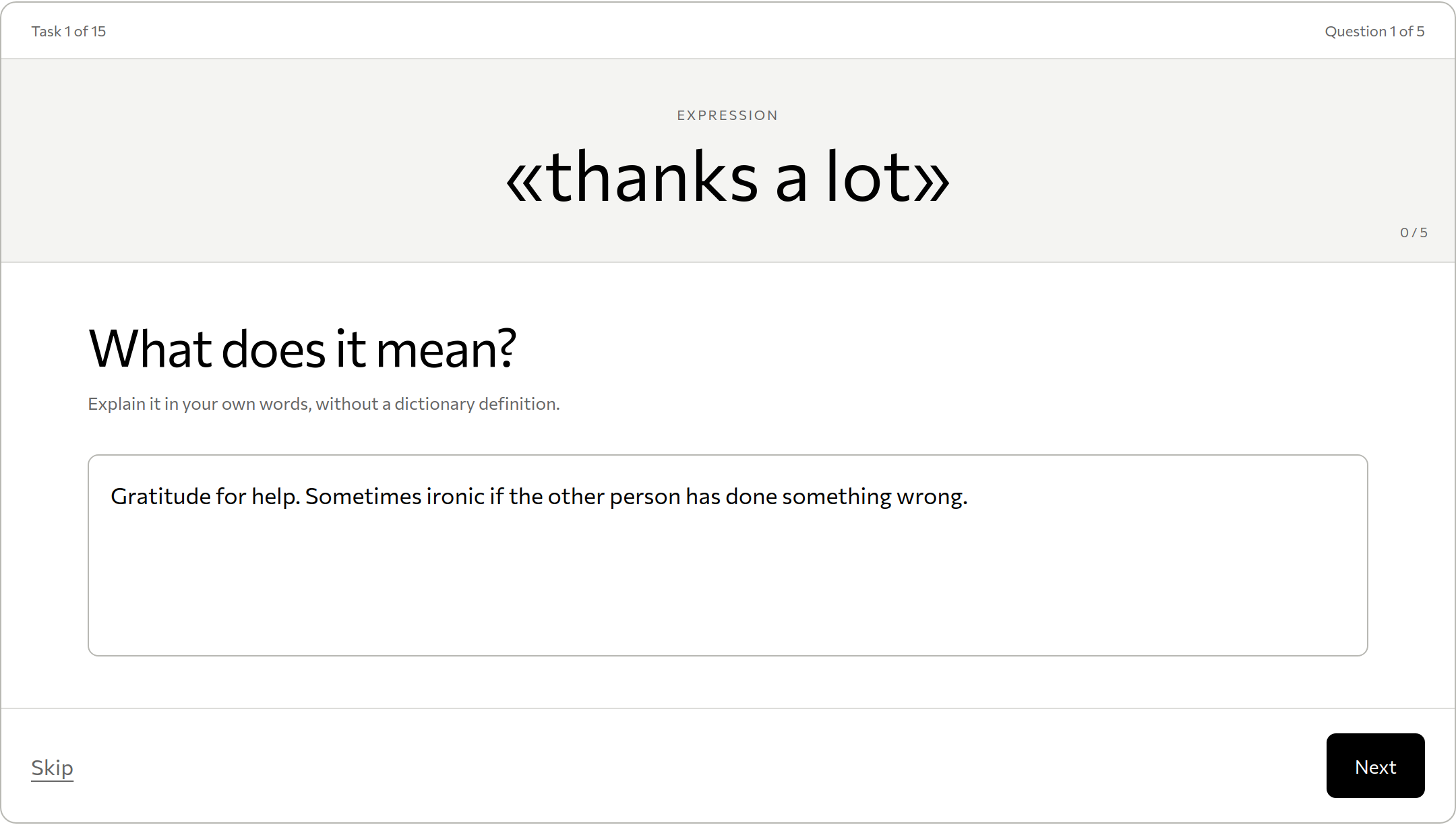
You do not have to arrive with your own idea every time. Tasks offers up to 15 fragments a day. Instead of one long questionnaire, you get five questions in sequence: what the expression means, when it is used, its tone, a natural example, and where you have encountered it.
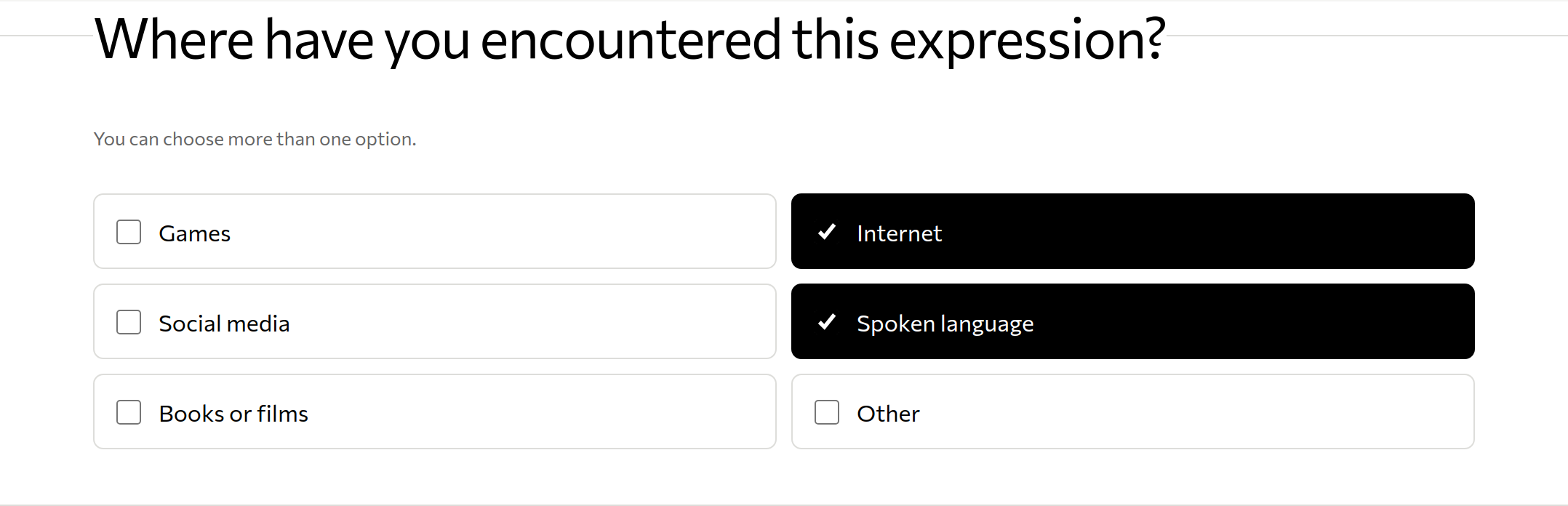
Answer one question and move to the next. You can select multiple sources: the same expression may appear online, in a game and in everyday conversation. If you do not know how to explain a fragment, choose Skip. There is no need to guess just to tick a box.
A skipped fragment leaves your pool and may go to another participant. You do not receive a replacement that day. The daily set refreshes at midnight in Yekaterinburg, and seven markers show completion over the last seven days.
Each fragment collects five suitable answers from different people, after review. This makes it possible to compare explanations instead of treating the first answer as the only truth. Differences matter too: an expression familiar to one community can mean something quite different in another.
Your experience can fit more than one option
You might hear an expression from friends, see it in comments and then encounter it in a game. Select the sources you actually know. You do not need to choose the “correct” one simply to satisfy the form.
The same applies to examples: a short, specific scene can explain more than a long, general definition. Who is speaking? To whom? What happened just before? These details help reveal meaning where otherwise there would only be words.
Submitting does not mean immediately training the model
Before submitting, you review your material and confirm the transfer terms. The material then goes through review. Not every text is suitable for further use, and submission alone does not mean it immediately enters training.
That is why independent writing and care matter. Do not include personal data, passwords, confidential information or other people's works. Do not replace your own contribution with automatically generated text. If you can invent an example without anyone's private details, do so.
Participation is unpaid and open to adults aged 18 and over. Before submitting, read the current rules and agreement linked on the platform. Contributors is not a private messenger or a place to store confidential conversations.
A clearer example can be a beginning
We want work with language to reflect not only the volume of text, but the diversity of human experience: how people explain, clarify, disagree, support one another and give the same phrase different meanings in different circumstances.
In the longer term, reviewed Contributors materials may help ORCNEIT prepare more informative data for its language model and study contemporary language. This is a direction of work, not a promise that every answer immediately changes the model or that the challenges of understanding are already solved.
Your contribution can begin with one expression you know well. A joke you often have to explain. A conversation where more than the final reply matters. Tell us what stands behind it.
Start with your own material or your first task. For participants aged 18 and over.
Try Contributors